
Leadership2 Aug 2026
The Governance Gap No One Wants to Own
PG
Subramaniam P G
Growth Architect · Executive Coach · Author
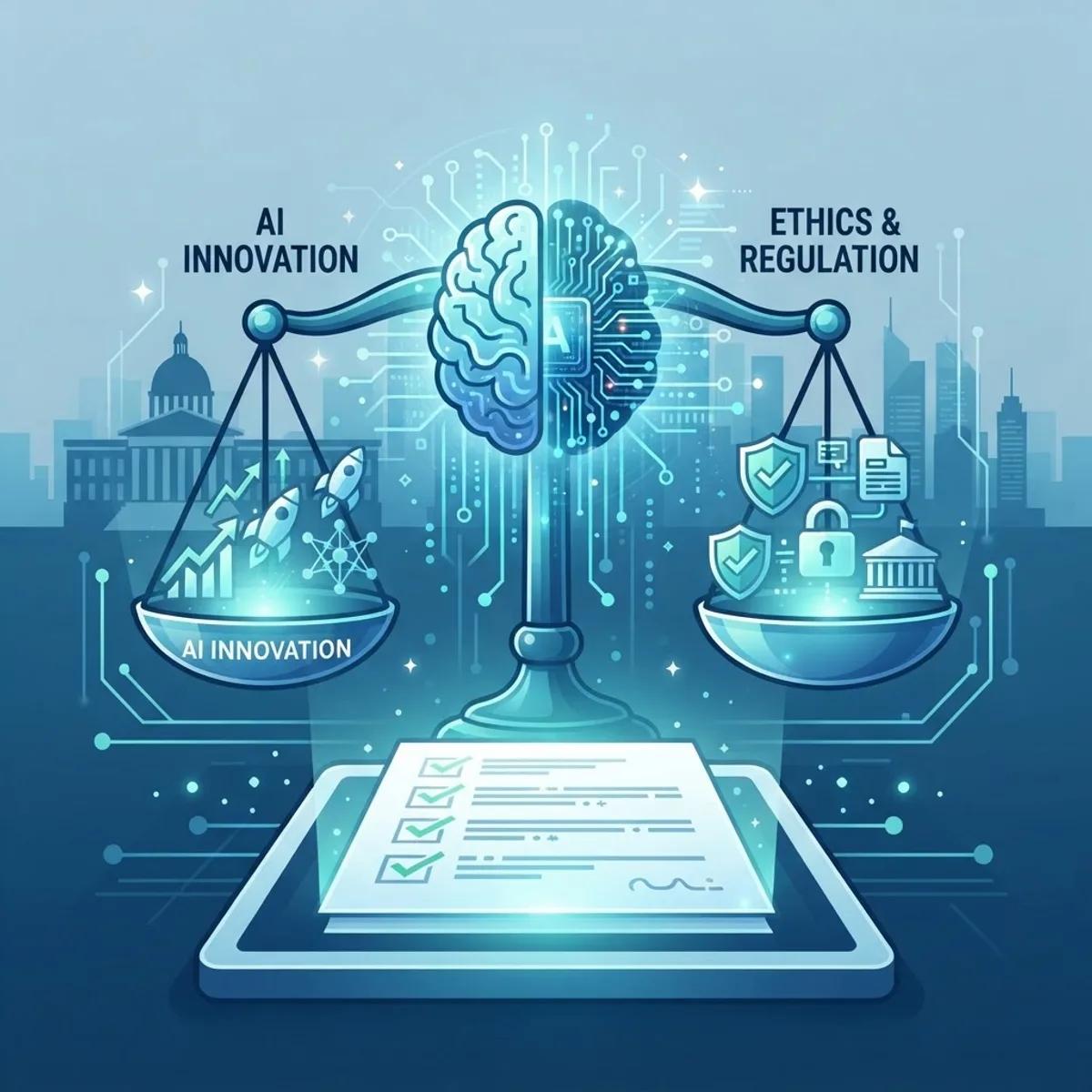
The Governance Gap No One Wants to Own
Every organization today faces a quiet contradiction. Artificial intelligence promises speed, insight, and efficiency. At the same time, it opens a door that many leaders have not yet learned to close. The tools arrive faster than the policies meant to govern them. Employees adopt them before anyone has asked whether they should.
This is not a future risk. It is a present one, unfolding inside companies that believe they are still preparing.
The Efficiency Trap
AI adoption inside organizations rarely follows a plan. It follows convenience. An employee finds a tool that drafts reports faster. A team discovers a dashboard generator that saves hours of manual work. A manager feeds customer data into an AI system to summarize a complex account.
None of this feels reckless in the moment. It feels productive. That is precisely the danger.
The efficiency gained is real. So is the exposure created. Confidential information, client intellectual property, and personal data often move into these tools without anyone pausing to ask where that data goes, who can see it, or whether it can be retrieved from the system later.
Organizations tend to notice this only after something goes wrong. By then, the damage is harder to contain.
Two Risks, One Blind Spot
There are two distinct pressures at play, and most organizations only see one of them clearly.
The first is client trust. Customers who share sensitive information with a company do so on the assumption that it stays within agreed boundaries. When that information is processed by an AI tool, the customer often has no visibility into this at all. If they discover it later, the damage is not only regulatory. It is relational. Trust, once broken this way, is difficult to rebuild.
The second is regulatory exposure. Most countries now enforce strict data protection laws, particularly around personal information belonging to employees, vendors, and customers. When personal data is exposed to AI systems without proper consent or safeguards, the organization is not just risking reputational harm. It is risking direct financial penalty, and in some jurisdictions, that penalty is severe enough to threaten the business itself.
The blind spot is this: most organizations manage these two risks separately, if they manage them at all. Legal teams think about compliance. Technology teams think about tools. Rarely does anyone own the intersection of the two.
Why Policy Alone Falls Short
The instinctive response to this problem is to write a policy. Draft a document. Circulate it. Ask employees to acknowledge it. Consider the matter closed.
This response is understandable. It is also insufficient.
Peter Drucker, one of the most influential thinkers in management, observed that "culture eats strategy for breakfast." A policy is strategy on paper. Culture is what people actually do when no one is watching. A rule against uploading confidential data into an AI tool means little if the culture around it treats convenience as more important than caution.
This gap widens further in a hybrid working environment. When teams work from different locations, with different levels of oversight, the informal social pressure that once reinforced good behavior in a shared office disappears. People find their own workarounds. Some of those workarounds involve AI tools that no governance framework has ever reviewed.
Rules alone do not change behavior. Behavior changes when people understand why the rule exists, and when that understanding is reinforced consistently, not delivered once and forgotten.
The Human Factor Behind the Risk
It is tempting to treat this as a purely technical problem, solvable through better systems and stricter access controls. Technology does matter. But the deeper issue is human.
Employees are not typically acting with bad intent. They are acting under pressure to deliver results quickly, often without full awareness of what the data they are handling actually represents, or what obligations the organization carries around it.
This is why sensitization matters more than punishment. An employee who understands that a client's proprietary information could be permanently absorbed into an external AI system behaves differently than one who has simply been told not to use a particular tool. The first employee makes better judgment calls even in situations the policy never anticipated. The second employee waits for the next rule to be written.
As one participant in a recent governance discussion put it, capturing the heart of this challenge:
"A policy tells people what not to do. Culture tells them why it matters. Only culture survives the moments no one is checking."
This is the real work of governance. Not simply restricting tools, but building the judgment that allows people to use new tools responsibly, even in situations that no document could fully predict.
Building a Structure That Can Hold
A workable path forward does not begin with perfection. It begins with visibility.
The first step is risk documentation. Before an organization can govern its use of AI, it must understand where AI is already being used, by whom, and with what kind of data. Many organizations are surprised to discover how widespread informal AI adoption already is, long before any policy was drafted.
The second step is structured consent. Where personal or confidential data is involved, clear frameworks must define what can be shared, under what conditions, and with whose approval. This is not a one-time legal exercise. It requires ongoing review as tools and use cases evolve.
The third step is continuous training, not a single onboarding session. Employees need regular, practical exposure to real scenarios. Not abstract warnings, but specific examples of what responsible and irresponsible use actually look like in their own daily work.
The fourth step is stakeholder engagement across functions. This cannot sit solely within legal, or solely within technology. It requires shared ownership between leadership, compliance, human resources, and the teams actually using these tools day to end.
None of these steps eliminates risk entirely. Herbert Simon, the Nobel laureate known for his work on decision making within organizations, wrote that managers operate not by finding the perfect solution but by finding one that is "good enough" under real constraints. This principle applies directly here. The goal is not a flawless system. The goal is a structured, honest, continuously improving one.
The Cost of Waiting
Every month an organization delays this work, exposure grows. New tools enter the workplace. New employees adopt habits without guidance. New data moves through systems that no one has reviewed.
Regulatory timelines rarely wait for organizational readiness. Many data protection frameworks carry strict reporting obligations and steep penalties for noncompliance, regardless of whether the organization intended harm. Intent is rarely a defense once a breach has occurred.
The organizations that will manage this transition well are not the ones with the most sophisticated technology. They are the ones that recognized the urgency early, treated governance as a continuous discipline rather than a single project, and built the internal culture needed to sustain it.
There is no perfect solution to this challenge. But there is a better one, built through structured guardrails, honest documentation, and consistent engagement with the people who use these tools every day. That path is available now, to any organization willing to begin.
Reflections and Action
- Where in your organization is AI already being used informally, without full visibility from leadership or compliance functions.
- Does your current approach to AI governance rely more on written policy or on genuine cultural understanding among your teams.
- Conduct a rapid internal audit this month to identify every AI tool currently in use across departments, along with the type of data each tool touches.
- Establish a recurring, short training session, at minimum quarterly, focused on real scenarios of data exposure risk rather than general policy review.
PG
Subramaniam P G
Growth Architect · Executive Coach · Author
Writing at the intersection of ancient wisdom and modern leadership since 2008.
About Subramaniam P G